 EN
EN


Weed-Proofing Outdoor Gravel Courtyards | A Practical Guide to Year-Round Maintenance and Cleaning
Gravel courtyards have become a popular paving choice for the private homes of overseas Chinese, thanks to their minimalist, high-end aesthetic, permeability, and moderate cost. However, many homeowners encounter pitfalls: while the result looks exquisite upon completion, within six months to a year, weeds run rampant through the gaps, fallen leaves accumulate and decay, and the stones become blackened and muddy—turning maintenance into a time-consuming chore. Drawing on a real-world renovation case study, this article shares techniques for preventing weeds at the source and a comprehensive year-round maintenance regimen, helping to keep gravel courtyards clean and tidy for the long term and achieving true low-maintenance results.
This case study focuses on a private courtyard belonging to an overseas Chinese family, featuring an outdoor gravel area of 65 square meters. The homeowner initially mistakenly believed that a gravel courtyard was a "zero-maintenance landscape" and had the gravel laid directly onto the existing soil without installing a base barrier layer. After eight months of use, significant issues arose: weeds sprouted profusely through the gaps, fallen leaves became buried and rotted within the gravel, and rainwater washed surrounding soil into the gravel layer, leaving the ground blackened and messy—severely compromising the courtyard's visual appeal. We subsequently optimized the base structure and implemented a standardized seasonal maintenance process, successfully achieving a result where weed growth was drastically reduced and daily upkeep became effortless over the following two years.
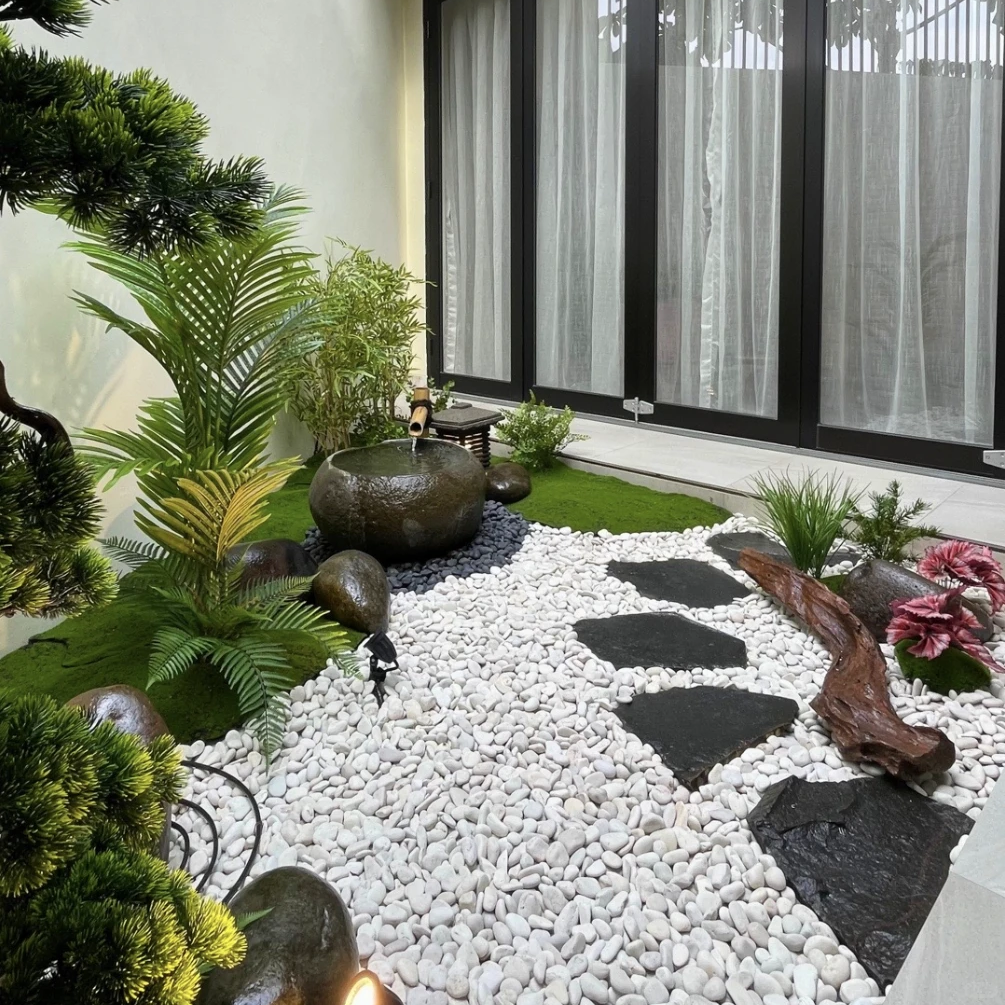
I. Two Practical Solutions for Preventing Weeds at the Source in Gravel Courtyards
Note: No technique can guarantee 100% weed-free results; wind-borne seeds will inevitably land on the gravel surface. The goal is to significantly suppress weed outbreaks at the source and reduce the workload of weeding.
Solution 1: New Gravel Courtyard | Weed Prevention Techniques During Construction
1. Base Pre-treatment: Thoroughly remove existing weeds and roots from the site and fully compact the ground to prevent future subsidence or soil churning up into the gravel.
2. Laying Anti-aging Geotextile Weed Barrier Fabric: Select professional-grade geotextile fabric with a weight of at least 150g/m². Overlap the fabric edges by 15–20 cm and secure them firmly with ground anchors; pay special attention to the seams, as this is where weeds most frequently emerge. Cheap, thin plastic sheeting degrades and crumbles quickly under UV exposure; its use is not recommended.
3. Install edging strips: Use stainless steel or rigid plastic edging to create a root barrier. This prevents surrounding lawn roots from spreading inward, stops rainwater from washing soil into the gravel area, and keeps the gravel from scattering or shifting.
4. Control gravel depth: Maintain a gravel layer thickness of 3–5 cm to fully cover the weed barrier fabric, preventing the fabric from being exposed to direct sunlight, which causes aging and damage.
Option 2: Remedial measures for existing gravel courtyards
1. Prioritize manually pulling existing weeds out by the root; frequent use of strong chemical herbicides is not recommended if pets or children are present.
2. Partially move the gravel aside to patch any torn or damaged weed barrier fabric; in areas where no fabric was originally laid, install geotextile fabric locally.
3. Secure loose or shifted edging strips, replenish gravel lost to foot traffic or rain runoff, and fill in any depressions or hollows.
4. Regularly clear out silt and fallen leaves from the gaps to minimize humus accumulation and cut off the nutrient source for weed seed germination.
II. Practical year-round cleaning and maintenance methods for gravel courtyards
Spring | Critical period for weed germination
1. Clear away dead branches and fallen leaves that have accumulated over winter across the entire gravel area. Decaying leaves create humus-rich soil, which serves as a breeding ground for weed seeds.
2. Check for gravel settling or exposed areas of the weed barrier fabric, and promptly replenish with new gravel.
3. Pull out young shoots as soon as they appear; removing them before their roots take hold makes the weeding process much more efficient.
Summer | Season of high temperatures and heavy rain
1. After heavy rain, promptly blow away or sweep up silt and sand washed into the gravel gaps. Silt accumulation is a major factor in weed proliferation.
2. Do not use high-pressure water jets directly on the gravel surface; the high-pressure stream can tear the underlying weed barrier fabric and churn up the soil beneath, exacerbating weed problems. For localized stains, simply use a low-pressure shower spray combined with a stiff-bristled brush.
3. Conduct a quick monthly inspection and promptly remove any scattered weeds.
Autumn | Peak Season for Fallen Leaves (High-Maintenance Period)
1. Fallen leaves are the biggest maintenance challenge for gravel gardens. Prioritize using a leaf blower to clear surface leaves; use a fine-toothed rake to gently gather smaller, fragmented leaves.
2. Avoid letting leaves rot within the gravel gaps for extended periods; decaying organic matter not only fosters weed growth but also stains the gravel black. If leaf accumulation is heavy, weekly cleaning is recommended.
Winter | Low-Temperature Dormancy Period
1. Clear away remaining dead branches and leaves; check edging strips for looseness or displacement.
2. Replenish gravel displaced by snow accumulation or foot traffic, and repair any depressions or uneven spots.
3. Avoid using salt-based de-icers on icy areas, as salt can damage surrounding plants and leave residues in the gravel gaps; prioritize using a rubber-edged snow pusher to clear snow.
III. Common Pitfalls and Misconceptions Regarding Gravel Gardens
1. Misconception: Gravel gardens require zero maintenance after installation. Reality: The underlying weed barrier only prevents growth from the soil beneath; wind-blown seeds landing in the gravel gaps can still germinate to some extent. It reduces maintenance frequency but does not eliminate the need for care entirely.
2. Misconception: Relying on herbicides for permanent weed control. Reality: Herbicides only kill existing weeds and do not address the root causes—such as the accumulation of silt and fallen leaves. Furthermore, chemical agents pose safety risks to pets and children in residential gardens.
3. Misconception: Using high-pressure washers for deep cleaning. Reality: High-pressure water can damage the underlying weed barrier, causing soil to churn up and exacerbating future weed problems.
4. Misconception: Skipping the edging installation process. Reality: Without edging, roots from surrounding lawns will encroach on the gravel area, soil will wash in with the rain, and gravel will scatter outward, quickly making the garden look messy and unkempt.
Summary of Project Outcomes
Through foundational structural improvements combined with standardized, year-round maintenance protocols, the likelihood of weed outbreaks has dropped by 85% over two consecutive years, eliminating the need for major surface renovations. Routine upkeep requires only 10–20 minutes per month to maintain the gravel courtyard’s clean, open aesthetic, truly achieving the goal of a low-maintenance landscape.
