 EN
EN


What Kind of Air-Permeable Substrate Suits Orchids, Pothos, and Foliage Plants
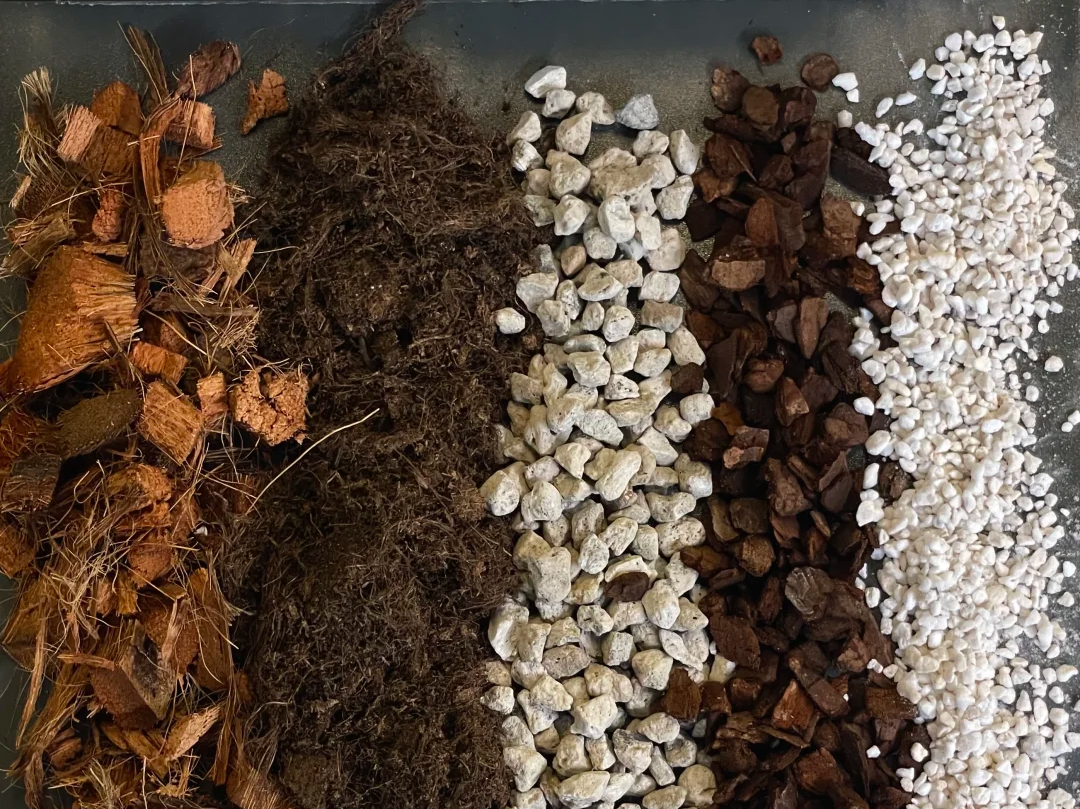
All three plant groups need air around their roots; the difference is how much. This guide uses measurable targets and common materials to explain what to choose and how to mix it.
1. "Airy" is a measurable number, not a feeling
Roots respire too. When a substrate stays saturated, water fills the pore space, oxygen in the root zone drops, and roots turn black and soft — the condition growers call root rot. So the essence of an airy substrate is this: how much air remains after a thorough watering.
Industry ranges are fairly consistent: air-filled porosity (AFP) is generally recommended at no less than 10%, and usually no more than 25%. Commercial substrates typically show total porosity of 75%–95%, air space of 10%–30%, and container capacity of 65%–80%. Sources: UC ANR, Soil Mixes Part 3: How much air and water?; Sun Gro, Air Porosity and Water-Holding Ability of Media Components.
One caution: a mix that feels loose when dry is not automatically airy when wet. Fine particles settle, break down, and fill the pores after repeated watering, so judge aeration in the wet state.
2. Quick reference: common airy materials
|
Material |
Strengths |
Limitations |
|
Pine bark |
Structural particle, resists decomposition, holds pore space long |
Must be composted: fresh bark heats up as it ferments and can damage roots; residual resin inhibits growth |
|
Perlite |
Light, fast drainage and aeration, low cost |
Crushes and breaks down, floats to the surface, short service life |
|
Pumice / volcanic rock |
Hard, does not crush, microporous, holds some water too |
Heavy, higher cost per volume |
|
LECA (expanded clay pebbles) |
Large pores, virtually non-degrading |
Big gaps between pebbles; used alone in soil it dries out around roots |
|
Sphagnum moss |
Strong water retention, good for wrapping new roots |
Compacts easily — packed tight, it becomes the least airy option |
|
Coconut coir |
Near-neutral pH, good water retention, renewable |
Some batches run high in salts (EC) and need rinsing; fine grades pack down |
|
Peat moss |
Holds water and nutrients, base of most commercial mixes |
Naturally acidic (commonly pH 3.5–5.0); hydrophobic once dry |
|
Vermiculite |
Holds water and nutrients, good for propagation |
Collapses under pressure, less airy than perlite |
3. Mixes for three plant groups (by volume; a starting point, not a rule)
Orchids need to be split into two groups. Epiphytic orchids (Phalaenopsis, Dendrobium, Cattleya) grow on tree trunks and rock faces in the wild, so the goal is to keep roots suspended in pores that breathe: coarse bark 60%–70% + pumice or LECA 20%–30% + a little sphagnum moss (≤10%). Terrestrial orchids (Cymbidium types) tolerate some fine material: particulate mix 60%–70% + leaf mould or peat 30%–40%.
Pothos depends on the route you choose. In soil: peat or coir 40%–50% + perlite 20%–30% + bark or pumice 20%–30%. Semi-hydroponics: LECA or pumice alone, with the water line kept below one-quarter to one-third of pot height. Water culture: submerge only one-third to one-half of the root mass and change the water regularly.
Foliage plants (Monstera, fiddle-leaf fig, Philodendron) do well with a general-purpose mix: peat or coir about 50% + perlite about 20% + bark or pumice about 30%. For these plants, particle size matters more than material choice — the larger the pot, the coarser the particles should be, otherwise the lower part of the pot stays wet for too long.
These ratios are not a standard recipe. Adjust them to your local humidity, pot size, and watering routine.
4. Three mistakes that are easy to make
Using garden soil or pure peat.
1. Fine particles fill the pores as soon as you water, and aeration starts declining from day one.
Chasing fast drainage only.
2. A pure-particle mix also holds little water, so roots cycle between drought and saturation. Aeration and water retention have to be met together.
Switching to a coarse mix without changing your watering routine.
3. Coarse particles hold less water, so watering on the same fixed schedule still harms the roots.
5. What to check when buying in bulk
Whether particle size is stated in millimetres (for example 3–6, 6–12, 12–25 mm); dust content and whether the material is screened or washed; the composting status of any organic component, with documentation; and pH and salinity (EC) data. Sampling and trialling a small batch before committing to a long-term recipe is the safer route.
Bottom line
Aeration is a wet-state property; materials divide the work by pore size and service life; and the recipe has to match pot size and watering habits. There is no "best" substrate — only the one that fits the rest of your setup.
