 EN
EN


Does perlite crumble into powder? A comprehensive guide to suitable applications for different perlite particle sizes
When selecting expanded perlite, many buyers and horticultural professionals focus on two key questions: Will the perlite crumble or turn to dust during use? And for which applications are the various particle sizes best suited? As a lightweight, porous, inorganic material, perlite is widely used in horticultural growing media, building insulation, and filtration applications. Factors such as product quality, particle size, and usage methods directly determine its service life and performance. This article breaks down the underlying causes of perlite crumbling and outlines the suitable applications for the full range of particle sizes to assist with selection and procurement.
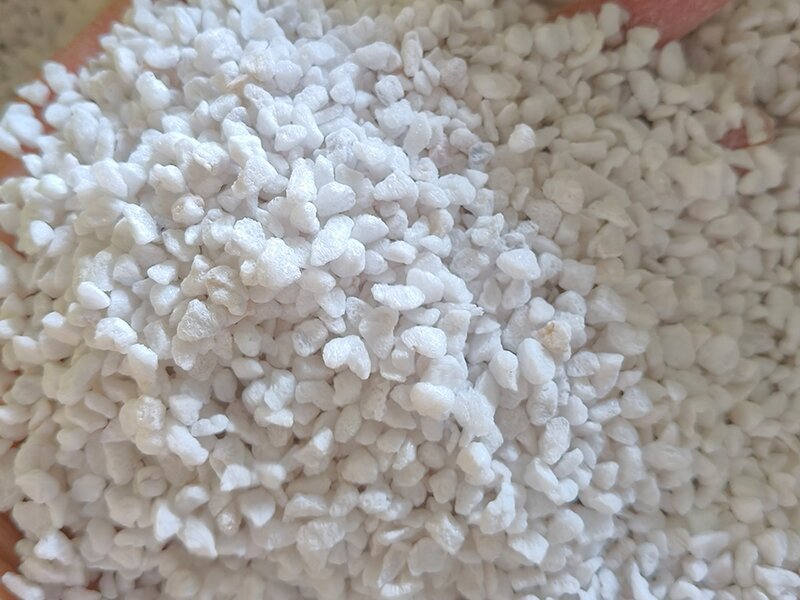
I. Does perlite pulverize?
1. The mechanism of perlite pulverization
Expanded perlite is produced by expanding volcanic glassy rock at temperatures exceeding 1,000°C, resulting in granules filled with internal pores. Perlite pulverization is not a process of chemical corrosion or decomposition; rather, it is a physical breakdown where granules shatter into fine powder due to external forces. Under normal operating conditions, high-quality expanded perlite maintains structural stability for 2–3 years. Larger granules offer greater resistance to pulverization, with a lifespan up to twice that of fine granules. Rapid pulverization occurs only under harsh usage conditions.
2. Main factors causing perlite pulverization
There are five primary factors contributing to perlite pulverization. First is external physical compression (critical impact level): frequent turning, heavy foot traffic, or repeated agitation directly causes granule breakage. Second is repeated wet-dry cycling (high impact level): alternating between water absorption and drying causes fatigue and damage to the porous structure. Third is poor raw material quality (medium-high impact level): perlite that is incompletely expanded or has a low closed-cell ratio possesses low inherent strength and crumbles easily. Fourth is prolonged immersion in standing water (medium impact level): continuous exposure to water erodes the granule's pore structure. Fifth is natural aging and wear (low impact level): gradual degradation over long-term use is a normal material characteristic.
3. How to delay perlite pulverization?
Prioritize high-quality perlite: Choose products with a closed-cell ratio exceeding 85% and full expansion; opt for hydrophobic perlite in damp conditions.
Standardize construction and usage practices:
Briefly rinse perlite before horticultural use to remove existing dust;
Control mixing duration when preparing mortar or growing media; avoid excessively vigorous mixing;
Minimize frequent soil turning or repotting for container plants to reduce granule abrasion.
Avoid harsh environments: Prevent perlite from soaking in standing water for extended periods; use hydrophobic-modified perlite in damp construction areas.
Regular inspection and replacement: If the growing medium becomes compacted and air permeability drops significantly, it indicates substantial perlite pulverization, necessitating timely replacement.
II. Application Scenarios for Perlite by Particle Size
Perlite specifications on the market are generally labeled in millimeters (mm) or mesh sizes; particle size directly determines water retention, aeration, and resistance to pulverization. The following outlines the mainstream specifications, covering both the horticultural and construction sectors.
1. Fine-Grade Perlite (0.1–3 mm)
Fine-grade perlite ranges from 0.1 to 3 mm (corresponding to 30–100 mesh). The 0.1–1 mm grade offers strong water retention and moderate aeration, making it suitable for seed starting, cutting substrates, and soilless seedling cultivation. The 1–3 mm grade balances water retention and aeration, and is commonly used for succulents, small potted plants, and vegetable substrate amendment.
Usage Tip: Fine perlite generates significant dust; it is recommended to moisten it with water before handling. It tends to float during watering, making it suitable for seedlings but less ideal for long-term, large-scale planting.
2. Medium-Grade Perlite (3–6 mm)
Medium-grade perlite ranges from 3 to 6 mm (corresponding to 14–30 mesh). The 3–4 mm grade offers good aeration and superior resistance to pulverization compared to fine grades; it is widely used for potted flowers and home gardening soil amendment. The large gaps between particles allow for rapid drainage, making it suitable for plants with fleshy roots—such as orchids and *Clivia*—as well as for planting tuberous flowers.
Usage Tip: This is the most versatile specification in horticulture, often mixed with coco coir and peat moss in a 1:1:1 ratio.
3. Coarse-Grade Perlite (6–12 mm)
Coarse-grade perlite ranges from 6 to 12 mm (corresponding to 8–18 mesh). The 6–8 mm grade features outstanding resistance to pulverization and excellent aeration, making it suitable for planting large potted nursery stock, rooftop gardens, and vertical greening projects. It drains quickly and maintains a stable, durable structure; it can be used for soil amendment in flowerbeds, as filter bed media, or as lightweight concrete aggregate.
Usage Tip: This grade has the longest lifespan among all horticultural specifications, making it ideal for long-term cultivation projects where frequent repotting is undesirable.
III. Selection Guide by Application Scenario
Horticultural Planting Selection Guide
For horticultural planting—specifically during the seed germination and seedling stages—perlite with a particle size of 0.1–2 mm is recommended, with an inclusion rate of 40–60%; its primary functions are moisture retention, aeration, and the protection of delicate young roots. For succulents and cacti, a particle size of 3–6 mm is preferred (50–70% inclusion rate) to ensure rapid drainage and effectively prevent root rot. Indoor foliage plants are best suited to 2–4 mm perlite (30–40% inclusion rate), balancing the substrate's needs for both moisture retention and aeration. For plants with aerial roots, such as orchids, a particle size of 4–8 mm (60–80% inclusion rate) is recommended to provide ample ventilation for the roots. Vegetable cultivation utilizes the 1–3 mm grade (20–30% inclusion rate) to improve overall soil structure. For large potted nursery stock, a particle size of 6–10 mm (30–50% inclusion rate) is recommended, as it can effectively reduce the frequency of repotting.
Construction Industry Selection Guide
In construction applications, perlite with a particle size of 30–50 mesh (1–2 mm) is recommended for exterior wall insulation layers; the core requirement is a thermal conductivity of ≤0.055 W/(m·K). Hydrophobic (water-repellent) perlite must be used here to prevent the material from pulverizing after absorbing water. For the pressing of insulation boards, a particle size of 20–30 mesh (2–4 mm) is recommended, requiring a closed-cell rate of ≥85%; mixing time during application should be limited to prevent particle breakage. Roofing insulation applications are suited to 1–3 mm perlite with a bulk density of 110–160 kg/m³; layered application is required to ensure even distribution. For lightweight concrete production, a particle size of 0.6–3 mm is selected, requiring a material strength of ≥0.5 MPa; the mixing ratio of cement to perlite should not exceed 1:3. When used as a water treatment filter medium, a 3–6 mm specification is adopted with a porosity of ≥70%; periodic backwashing is required during operation to prevent clogging.
IV. Summary
The pulverization of perlite is not inevitable. By selecting high-quality expanded perlite with a high closed-cell ratio, choosing the appropriate particle size for the specific application, and employing correct usage methods, the issue of pulverization can be effectively mitigated. A simple rule of thumb for selection: smaller particle sizes offer better water retention, while larger particles provide superior air permeability and wear resistance.
If you require perlite samples or customized particle size specifications, please contact us for detailed product parameters and pricing.
